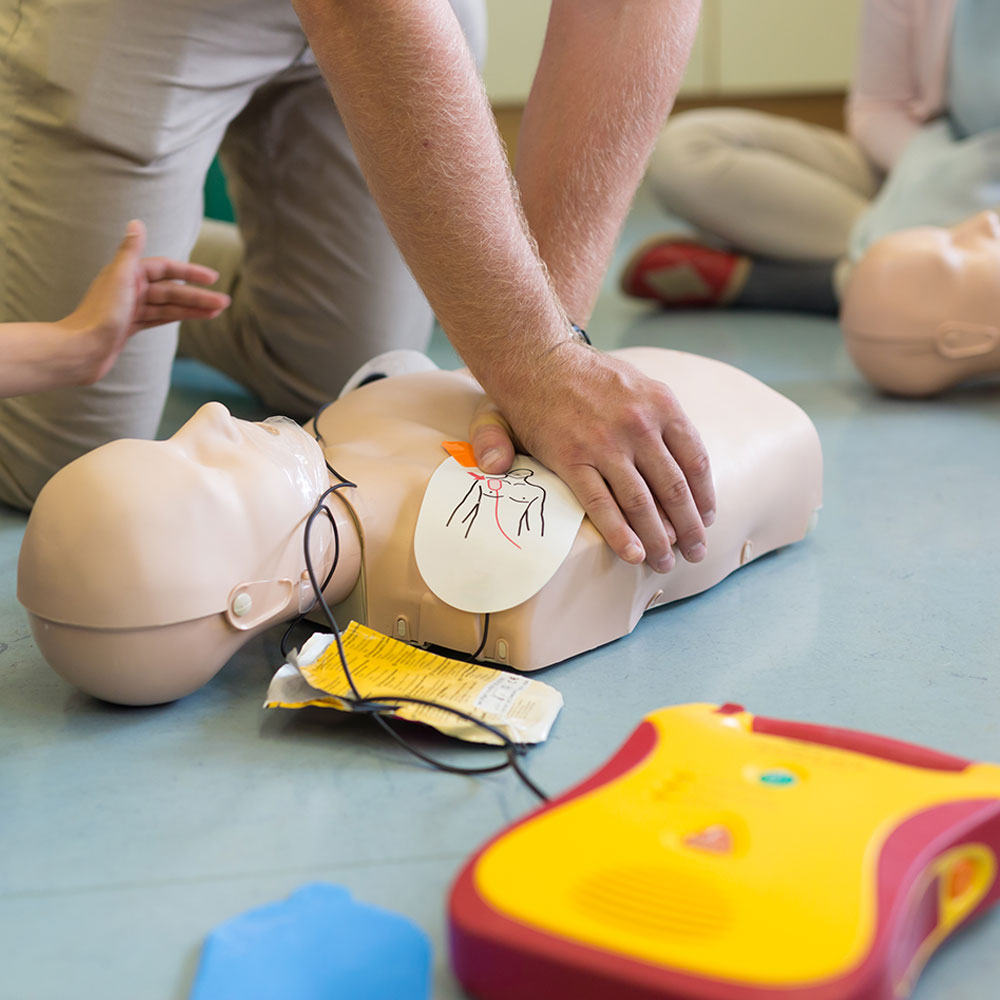
Learning How To Use an AED
8 Complete Steps for Using an AED Machine
Turn on the AED
Press the power button to turn on the AED. Follow the voice prompts for further instructions.
Remove the Clothing
Remove the patient’s clothing from their chest. If necessary, dry the chest and remove any excess chest hair.
Prepare the Electrode Pads
Tear open the electrode pad packaging. Peel the adhesive pads from the blue backing.
Place the Electrode Pads
Apply the electrode pads to the patient’s bare chest.
Do Not Touch
Do not touch the patient when instructed.
Press “ Shock”
Press the “Shock” button if advised.
Perform CRP
Perform CPR. If necessary.
Continue Following the Instructions
CardioPulmonary Resuscitation (CPR) Guide
We believe that everyone has the power to save a life. Explore the critical importance of CardioPulmonary Resuscitation (CPR) and how immediate intervention can make a difference. Learn from real-life stories of resilience and survival.
CPR is not just for healthcare professionals. Discover why CPR knowledge is crucial for parents, teachers, caregivers, and anyone who wants to be a proactive first responder. Uncover the benefits of CPR training in various settings, including the workplace.
Here we summarized the CPR Steps for your quick learning.
Save a Life with DRSABCB
Danger (D)
Ensure scene safety.
Response (R)
Tap shoulder if no response call 999 for an ambulance or send someone do for you -> Check for breathing at least 5 seconds but not more than 10 seconds -> If unconscious and not breathing/not normal breathing start CPR.
Shout the Help (S)
Call 999 and get AED.
Airway (A)
Breathing (B)
- Check for normal breathing for no more than 10 seconds.
- Start chest compressions if the person is not breathing or if they are breathing abnormally (e.g., gasping).
Circulation (C)
Perform chest compression. Push at a rate of 100 to 120bpm for 30 compressions and 5 cycles.
Ratio of CPR is 30 chest compressions: 2 breaths for 5 cycles.
Defibrillation (D)
If an AED is available, use it immediately once CPR has started, and follow its instructions.
Difference Of Chest Compression Technique
For Adult / Children / Infant
| Component | Adult | Children | Infant |
|---|---|---|---|
| Hand placement | 2 hands on the lower half of the breastbone | 2 hands or 1 hand (optional for very small child) on the lower half of the breast bone | 2 fingers in the middle of the chest just below the nipple line |
| Compression depth | At least 5 cm but not more than 6 cm | About 5 cm | About 4 cm |
